How Far Can an E-Bike Go? Battery Range Explained
Ask any e-bike rider what they worry about most and the answer is usually the same: will the battery get me home? Range is the number one question for new buyers, and also the one with the least straightforward answer. A bike might claim 100 km on a good day and deliver 40 km on a hilly one. This guide explains how e-bike range works, what affects it, how to estimate your own range and how to get more out of every charge.
The short answer
Most e-bikes will go somewhere between 30 and 100 km on a charge, depending on the battery size, how much assistance you use, the terrain, the rider and the load. That is a wide range, so it helps to understand the factors and do a simple calculation for your own riding.
Start with watt-hours
Battery capacity is measured in watt-hours (Wh). It tells you how much energy the battery stores. A 500 Wh battery holds twice as much energy as a 250 Wh battery. Watt-hours are the best number for comparing batteries, because they combine voltage and amp-hours into one figure. You calculate them by multiplying voltage by amp-hours: a 48 volt, 19 amp-hour battery stores about 912 Wh. We explain this in our e-bike battery guide.
A simple way to estimate range
Range depends on how many watt-hours the bike uses per kilometre. As a rough guide only, many e-bikes use somewhere between about 5 and 15 Wh per kilometre depending on assist level and conditions. Divide the battery capacity by the energy used per kilometre to get an estimate. For example, a 500 Wh battery at 10 Wh per kilometre would give roughly 50 km. In gentle conditions with low assist it could be more, and with heavy loads, hills and high assist it could be much less. Treat this as an illustration, not a promise.
What affects e-bike range?
- Assist level. High assist modes drain the battery faster. Use the lowest level that works.
- Terrain. Hills use much more energy than flat ground, and wind has a big effect.
- Rider and load weight. More weight means more energy to move it, which matters on a cargo bike.
- Tyres and pressure. Wide, soft or under-inflated tyres roll less efficiently. Fat tyre bikes use more energy on smooth roads.
- Temperature. Cold weather temporarily reduces battery output and range. Heat over time reduces battery capacity.
- Stop-start riding. Frequent starts use more energy than steady cruising.
- Your pedalling. The more you contribute, the less the motor has to supply.
- Battery age and condition. Capacity declines slowly over years, and good care slows this down.
Why manufacturer range claims differ from your experience
Range figures are usually produced in ideal conditions: a light rider, flat terrain, mild weather and a low assist level. Real riding with hills, wind, stops and a bag on the back will usually give less. That is why watt-hours and your own conditions are a more useful guide than a single headline number.
Examples from our range with stated battery sizes
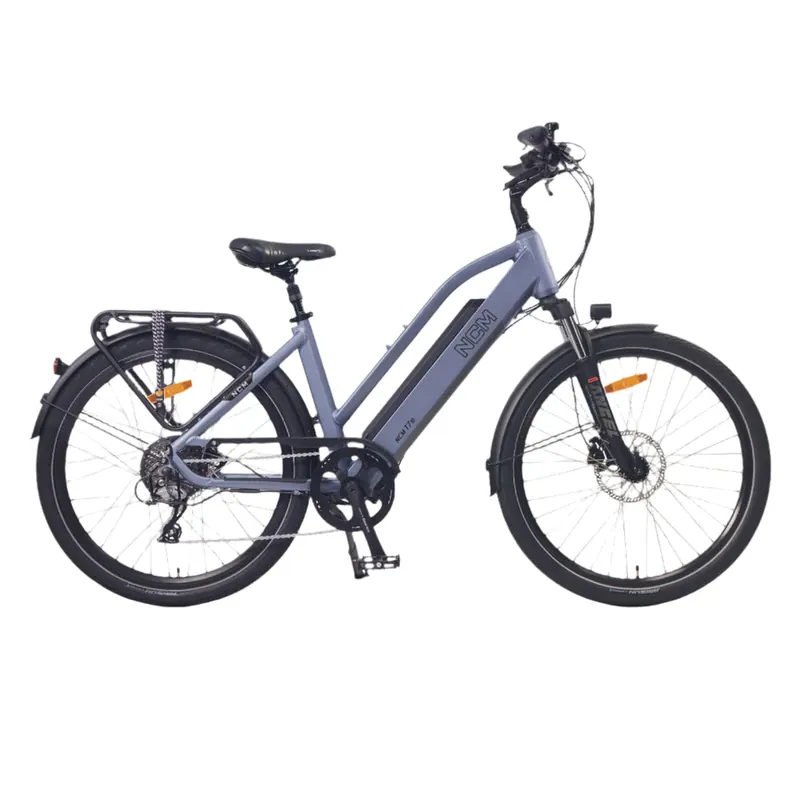
Where a battery size is part of a model name, it is a handy way to compare. Examples include the NCM T7s Step Thru Trekking at $2,399 with a 912 Wh battery, the NCM Cru7 cruiser at $2,799 with 912 Wh, the Kalkhoff Image 1.B Move at $2,599 with 500 Wh and the Bianchi E-Omnia T-Type at $4,799 with 625 Wh. Check each product page for battery details.
How much range do you actually need?
Think about your longest regular trip and add a safety margin of at least 30 to 50 percent. If your daily commute is 20 km each way, you ride 40 km a day, so a battery that comfortably delivers 60 km or more per charge means you only charge every day or two and you are never stranded. If you ride short trips of 5 to 10 km, a smaller battery is fine and keeps weight and cost down.
How to get more range
- Use a lower assist level on flat sections and save high assist for hills.
- Keep tyres at the correct pressure. This is the easiest range gain.
- Pedal smoothly in a suitable gear. Avoid grinding in a high gear at low speed.
- Anticipate stops and coast where possible.
- Carry less weight.
- Keep the chain clean and lubricated to reduce drag.
- Store and charge the battery properly to protect capacity: see our battery care guide.
Range extenders and second batteries
If your bike supports it, a range extender adds capacity. Examples in our range include the Hyena Range Extender Battery 250Wh at $839.99 and the Hyena Gen 2 In-Tube 250Wh Battery at $639.99. These are compatible with specific systems, so check compatibility or ask our team before ordering. Browse ebike batteries and chargers.
Range on different types of bike
- Commuter bikes: designed for steady distance, usually with larger batteries.
- Mountain bikes: hills and technical riding use more energy per kilometre.
- Folding bikes: often smaller batteries for weight, and ideal for shorter trips.
- Cargo bikes: heavy loads need big batteries.
- Fat tyre bikes: more rolling resistance on pavement, so plan for less range.
See electric commuter bikes, electric mountain bikes and folding electric bikes.
A worked example: planning a commute
Suppose you commute 15 km each way, which is 30 km a day, with a couple of moderate hills. If you use around 10 Wh per kilometre as a planning figure, you need about 300 Wh for the day. A 500 Wh battery would therefore leave a comfortable reserve, and you could charge every second day. If your route is much hillier, or you carry a heavy bag, use a higher figure such as 14 Wh per kilometre, which gives 420 Wh a day and suggests a bigger battery or daily charging. Doing this simple sum before you buy keeps you from choosing a battery that is too small.
How weather and seasons change range
Range is not a fixed number across the year. In winter, a cold battery delivers less energy and the bike may show a shorter range until it warms up, so keep it indoors until you ride. Strong headwinds can cut range by a surprising amount, because you and the motor have to work harder. In hot weather the battery works normally but ages faster if it is left in heat, so keep it in the shade. Planning for a margin in every season prevents surprises.
Climbing: where range goes
Hills are the biggest drain on a battery, because you are lifting your weight and the bike's weight against gravity. A route with a lot of climbing can use two or three times the energy of a flat route of the same length. The good news is that descents let you coast, and some systems recover a little energy. If you ride hilly terrain, choose a bigger battery and a drive system with strong low-speed torque, and plan your assist levels so you do not run out before the last climb.
Charging and how long it takes
Charging time depends on battery size and charger output. A larger battery or a lower-amp charger takes longer. Most riders charge overnight or at work. Use the charger supplied with your bike, charge indoors and unplug when full.
Frequently asked questions
Is a bigger battery always better? Not always. It gives more range, but it costs more and adds weight. Match capacity to your trips.
Does the battery lose range over time? Yes, slowly. Good care keeps it high for years.
Can I ride without the battery? An e-bike is heavier than a normal bike, so riding with no assist is harder, but it works.
What if I run out of charge? You can pedal home, though the bike is heavy. Plan your ride with a safety margin.
Ready to choose?
Browse electric bikes for sale and compare battery sizes on each product page. Pay by bank transfer, Osko or crypto to save 10%. Ask our team to help you choose the right battery for your rides.
Get a free quote
Tell us the bike you have in mind and your delivery postcode. Our Australian team replies with the delivered price, including free delivery and the 10% bank transfer, Osko or crypto discount.
Ready to find your perfect electric bicycle?
Explore our range with 100% free delivery across Australia.
Related Australian Cycling Guides
E-Bike Battery Guide: Volts, Amp Hours and Watt Hours
Understand e-bike batteries: volts, amp hours and watt hours, how to match a battery and charger to your bike and how to choose a replacement or range extender.
How to Choose the Right E-Bike Size and Fit
Buying an e-bike online? Learn how to measure yourself, read a size chart, set up the saddle and handlebars and fix common fit problems for a comfortable ride.